The Rome Roam
This document is best viewed at a screen resolution of 1024 by 768 pixels.
Rome
The first memories of Rome are to do with the taxi queue at the Leonardo da Vinci Airport - we spent over an hour there just waiting for a taxi to take us to town!
Thankfully though, the taxi trauma was soon forgotten because the best thing that happened to us in Rome was our chance meeting with
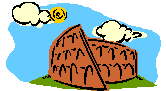
Jim, a one-time student of Italian art and history who now conducts walking tours around the ancient parts of Rome. His Colosseum tour (like all his others) is so good that many people sign up for his other tours as a result. We did, and would enthusiastically recommend them: you won't regret it!The Colosseum (72 AD) or the Flavian Amphitheatre as it was originally called, was a place for amazingly brutal sports, mainly fights between gladiators and a variety of animals, including bulls and tigers. It's a huge building with 5 floors for spectators, and 2 basement floors for the animals and gladiators (which included slaves, Christians, petty criminals, and prisoners). As Jim explained the way the fights would go on, where the people sat, where the performers came out from, where the animals were let out from, our hair stood on end: it was almost like we were witnessing this sport all those centuries ago. Eeekk!
Of course, I remember the Colosseum more for Bruce Lee's classic fight with Chuck Norris in The Return of the Dragon. The amphitheatre derives its name from the colossal statue of Emperor Nero which stood nearby about two millenniums ago.
Ancient Rome (750BC to 400 AD), includes the ruins of the Roman Forum and the Imperial Forums. Remnants of an entire civilization can be seen in these ruins, including temples, a Senate Room, various arches built by triumphant warriors, and even the rostra from where Mark Antony made his "Friends, Romans & Countrymen ... " speech! At this point, Jim brought history alive by standing on the rostrum and repeating the entire speech with all the fervour and feeling that Mark Antony would have had on Caesar's assassination. Superb!
Other highlights include the ruins of the temple of the Vestal Virgins, Via Sacra - a cobblestoned 2000 year old road, and Trajan's column, a beautifully ornamented pillar. With Jim explaining the background of some of these ruins, it seemed like every brick had a tale to tell!
~
TIP: We strongly recommend taking a guide for the Ancient Rome tour to make the otherwise decrepit ruins come alive. Without someone to explain, the Roman Forum can be a BIG anticlimax: just a group of partly standing brick structures, like a site that's partly cleared up by a bulldozer for fresh construction!The stories we read in our history books about the city of Rome being founded on 7 hills by two brothers, Remus and Romulus, was depicted on Capitoline Hill as a sculpture of a she-wolf with a pair of twins. The road from the Imperial Forum to the Capitoline Hill passes close to the Mamartime prison, where Peter and Paul were jailed by the emperor and from where Peter made his escape (symbolically representing an escape from Christianity) before Christ caught up with him and uttered those famous words - "quo vadis" (which means "where goes thou"; not to be confused with Bata's famous line of leather sandals for men!). Peter also saw a sign in the sky and the believer that he was, this was enough to convince him to return to Rome and become a saint and take up the responsibilities as the first Pope!
Classical Rome: We took a short coffee and cake break before we joined Jim for an evening tour of classical Rome.
We began at the Piazza Venezia where stands the Vittorio Emmanuelle II monument which is a 20th century building sitting over several centuries of Roman ruins. The locals don't like this building very much and call it alternatively a typewriter or the wedding cake (you will understand why as soon as you see it). Apparently, from a balcony across the piazza, Mussolini made speeches to his soldiers who marched in the monument in their black uniforms, giving the impression of the movement of typewriter keys! Over a century before Mussolini, Napolean's mother also had a balcony around this piazza where she eavesdropped on conversations of passers by!
We walked on to The Trevi Fountain - Fontana di Trevi, popularised by Anita Ekberg's aquatic frolic in the movie "La Dolce Vita" and Frank Sinatra's song "Three coins in the fountain". There are various small nondescript streets that lead to the fountain, which appears suddenly as these tiny streets open up into the enormity and beauty that is the Trevi Fountain, an effect intended by the sculptor, Nicola Salvi. The Trevi Fountain is beautiful both by day and night, with a lot of people using it as a meeting spot. The theme of the sculpture at the fountain depicts the two contrasting aspects of water - on one side is the wild and raw power of water depicted by an unruly horse which is being reined in by the man. On the other side is the tamed and serene face of water, as shown by another regal horse.
~
TIP: Take a people watching break here, with deliciously fresh ice-cream from the gelati shop at one corner of the fountain. Don't forget to wish at the fountain with three coins thrown over your shoulder with your back to the fountain!We then walked on to the Pantheon - it has a porch with 16 tall pillars which were made and transported all the way from Egypt, and were reportedly so heavy that some of the barges bringing them sank, and these 16 are all that remained! There is a natural sundial on the circular dome roof. The Pantheon is an inspiration for many latter day artists. In fact, when Michelangelo designed the dome of St. Peters' Basilica at the Vatican, he copied the idea of the Pantheon dome design but kept it smaller out of respect! The Piazza della Rotunda outside the Pantheon was one of our favorite piazzas: much smaller than Navona, but really cosy and nice on a sunny winter weekend morning. Raphael, the renowned renaissance artist, lies buried in the Pantheon.
We walked further to Piazza Navona - its very large, with 3 different sets of sculptures, a church with Borromini façade, a Bernini fountain with water god and representation of 4 rivers, café tables, performers, painters, stalls.... Incidentally, your guide will tell you that two of the four statues facing Borromini's sculpture on the church front, which are hiding their faces, are doing so because they don't want to look at the hideousness of Borromini's work (Bernini and Borromini were big rivals). I read later on that Borromini's sculpture on the church came up later than Bernini's fountain, but its interesting to listen to these stories.
The Spanish steps - Piazza di Spagna - is another famous place for relaxing and passing time but we personally didn't like it as much as the other piazzas. The Spanish steps are close to the high priced, branded shopping district where the Armanis and Moscshinos rule.
Another meeting place worth mentioning is the Piazza del Popolo, with the ubiquitous pigeons, figurines adorning fountains, and Egyptian obelisk. There are Egyptian obelisks all over Rome, and they are all about 3000 years old. I can almost imagine the Roman emperors asking their queens what they would like from Egypt when they went on a campaign and the answer would always be "the latest obelisk"!
~
TIP: Our vote for the best piazza in Rome would be split between the Piazza della Rotunda and the Piazza Navona. While Piazza della Rotunda is an absolute winner for daytime relaxing and people watching, Piazza Navona comes to life at night, taking on an altogether different character. Invest your time at these places - you won't regret it.The Vatican City was undoubtedly the highlight of our Roman sightseeing adventure. The
Vatican City can easily take 2 full days, depending on how detailed your tour is. We had only half a day with us since Easter mass was to be held that evening and we had to rush through, so our impressions may not be as detailed. Also, due to the Easter break, the crypts in the basement of St. Peter's Basilica were closed, but the Fodor's guide recommends it strongly, as something not to be missed.Predictably, there is always a long queue to get into the Vatican Museums - the world's best repository of renaissance art. Works of Bernini (bronze work inside St. Peter's), Michelangelo (Sistine Chapel wall and ceiling), and Raphael (tapestry rooms and frescoes) are the highlights. An apocryphal story goes that in the back wall of the Sistine Chapel, Michelangelo's last day of judgement, has one of his enemies depicted as a villain going to hell. When this said enemy complained to the Pope, the Pope replied that he had control over heaven and earth, but was helpless when it came to hell!
The St. Peters basilica has more of those masterpieces - large sculptures, paintings and statues including Michelangelo's La Pieta (Pity) which is the statue of the Virgin Mary with a Jesus almost dead from crucifixion lying on her lap. Bernini's bronze chair and the bronze canopy (we don't remember its actual name anymore - a result of having only an hour to visit St. Peter's) is quite grand.
The Vatican City's treasures can very easily cause major sensory overload as it did for us. Towards the end, we were passing by these masterpieces so casually that I felt sorry for their creators. For people who have the time, the Vatican city is best done in bite sized pieces. For the others, take the short tour (highlighted in the museum) and focus on the really famous masterpieces and arts of different kinds (tapestries, frescoes, etc). Outside St. Peter's, make sure you check out the Swiss Guards in their colourful splendour (even their uniforms have been designed by Michaelangelo) and the colonnade in all its daytime grandeur.
Had enough? Click here to return to our
Wanderlust web page. Or continue the city tour to Firenze.

© Vixabs Vacations Unlimited
May 08 2003